
The Exit Note
What He Heard From Seoul
By the time Ma told Vinja that Jiejie had turned the music back on, Seoul had already gone dark outside his hotel window. He stood near the glass with his phone pressed to his ear, looking down at the headlights moving through the streets below. “What kind of music?” he asked. “Reggae.” “Reggae?” “Nineties reggae. Loud enough for me to hear it from the kitchen.” Vinja said nothing. Ma continued before he could turn the information into another round of questions. “She was in her workroom. She had tools everywhere, two sketches taped to the wall, and one earring in her hand.” “Was she eating?” “I brought her food.” “That wasn’t my question.” “She ate.” “How much?” “Enough.” “Ma.” “Vinja.” He closed his eyes. On the other end of the call, Ma laughed quietly. “She was dancing.” Vinja opened his eyes again. “Dancing?” “More like bopping while pretending she wasn’t dancing. Then the next song came on and she stopped pretending.” The tension he had carried across the Pacific did not disappear, but something inside it loosened. “Did she know you were watching her?” “She knows now.” “What happened?” “She told me to stop standing in the doorway looking at her like she had risen from the dead.” Vinja turned away from the window. “That sounds like her.” “It does.” Ma’s voice softened. “She’s getting better, baby.” Vinja sat on the edge of the bed. “She said that?” “She didn’t have to.” He looked toward the closed notebook resting on the desk. “Keep checking on her.” “I am her mother.” “I know.” “I was checking on her before you assigned me the job.” “I didn’t assign—” “You called from South Korea and gave me instructions.” “I asked for help.” “You told me to make sure she wasn’t surviving on pizza and wings.” “Was she?” There was a pause. “She had ordered wings.” Vinja pointed toward the empty hotel room as though Ma could see him. “I knew it.” “But she also ate the food I brought.” “Go back tomorrow.” “I am not going to her house every day because you have decided to become an international food monitor.” “Not every day.” “Good night, Vinja.” “Ma—” The call ended. Vinja stared at the phone for several seconds before setting it beside him. Then, for the first time since arriving in South Korea, he allowed himself to believe Jiejie when she said she was going to be all right. Not untouched. Not unchanged. But moving.
The Old Page
The hotel room was quiet after the call. It was a different kind of quiet from the one Jiejie had requested at home. Her silence had been protective—a space cleared for rest. This silence felt expectant. Vinja crossed to the desk and opened his notebook. The spine had softened from years of travel. Receipts, transit cards, folded maps, and scraps of paper protruded from different sections. Some pages held careful observations. Others contained single lines written quickly before a thought escaped. He turned past notes from airports, hotel lobbies, palace courtyards, markets, train stations, and the impossible places the Portal had taken him. Eventually, he found the page he had written at the kitchen table before leaving home. The handwriting was slower there. More deliberate. I have made myself very good at being the branch. It has always felt like rest, not diminishment—and perhaps, for a long time, it was. But rest and hiding do not always announce themselves differently. I am not certain yet what to do with that. I am only certain I noticed it. Vinja read the passage twice. When he had written it, he had not known what came next. He had recognized something inside himself but resisted turning that recognition into an immediate decision. He did not want to mistake discomfort for revelation or destroy something good simply because he had finally examined it closely. Home was good. Life with Jiejie was good. Being allowed to rest beside someone without having to lead every moment was not weakness. The problem was never that Vinja became a branch when he came home. The problem was how easy it had become to remain one until someone else’s needs gave him a reason to move. Jiejie’s disappearance had almost pulled him deeper into that habit. He could have canceled the trip completely. He could have remained in the hallway outside her bedroom, monitoring every meal, every hour of sleep, every silence, and every closed door until his care became another burden she had to manage. Instead, Jiejie had told him what she needed. Quiet. Prayer. Work. Time. Then she had told him to leave. Not because she wanted him gone. Because she trusted herself to heal without requiring him to stop living. Vinja picked up his pen.
The Exit Note
He wrote the date at the top of a clean page. Below it, he wrote one word. Exit. He looked at it for a moment. Then he drew a line through it. The word suggested escape. That was not what he wanted. He tried again. Departure. Closer. Still incomplete. Vinja rested the pen against the paper and listened to the muted traffic beyond the hotel glass. Then he began writing. I thought leaving required dissatisfaction. That a person only moved away from a life when the life had become too small, too painful, or no longer worth keeping. But perhaps departure does not have to be a rejection. Perhaps I can leave because home is secure enough to remain home without my constant presence. Jiejie does not need me to stand outside every closed door. She knows how to open one when she is ready. I do not need a crisis to justify movement. I do not need to wait until someone sends me somewhere, pulls me somewhere, or needs something from me. I can choose the road before the road chooses me. Vinja paused when his phone lit with a message. A photograph from Jiejie. He opened it. An unfinished pendant rested against a square of black cloth. Its outer frame followed the curved shape of a palace window, but the center was open. Fine metal lines swept outward from the edges instead of crossing over the middle. Beneath the photograph, Jiejie had written: Still working on it. Do not critique the clasp. Vinja smiled. He replied: The clasp needs work. Three dots appeared almost immediately. Then: Blocked. He placed the phone facedown and returned to the notebook. The branch was never the prison. Hiding was. Home can remain the place where I rest without becoming the boundary of my life. I am not leaving home behind. I am leaving from it. Vinja underlined the final sentence once. Then he turned to the next page.
The Plan
At the top, he wrote: South Korea Beneath it: Seoul → Jeonju The first portion of the trip belonged to family. His mother had waited months to see him. His father had reserved private rooms, scheduled meetings disguised as meals, and built an itinerary dense enough to make spontaneity nearly impossible. Vinja would honor that time. He would sit through the dinners. Answer the questions he chose to answer. Allow his mother to feed him as though America contained no food. Listen to his father discuss companies, family obligations, and every respectable path Vinja had declined to follow. But afterward, he would not immediately fly home. He drew a line beneath the family schedule. Under it, he wrote: Jeonju — alone No driver. No family assistant. No carefully managed route designed by someone who believed convenience and control were the same thing. He wanted to walk. He wanted to follow the old paper road through workshops where hanji was still made by hand. He wanted to watch the fibers being soaked, beaten, lifted, pressed, and transformed into something strong enough to survive centuries. He wanted to ask what remained of a place after generations had folded themselves around it. He wanted to listen without deciding in advance what his Korean heritage was supposed to mean to him. Vinja wrote: Do not arrive looking for proof that I belong. Do not arrive prepared to prove that I do not need to. Observe first. He drew a small box beside the final line and left it unchecked. Then, beneath the Jeonju notes, he wrote the next destination. Japan — Kyoto That page remained mostly blank. For now, it was enough to name the direction. South Korea first. Then Japan. Then home. Not home as surrender. Not home because he had exhausted every other possibility. Home because returning could also be a choice.
Where the Story Opened
Vinja closed the notebook and slipped it into his bag. His father’s car would arrive early the next morning. There would be breakfast, then a meeting, then the private dinner his mother had been afraid he would miss. After that, the schedule in his notebook belonged to him. He stood at the hotel window one last time. Far below, Seoul continued moving without waiting for him to decide what role he would play inside it. For most of his life, Vinja had been skilled at entering worlds that already had a place prepared for him. Son. Traveler. Observer. Problem solver. Branch. This time, he was not waiting to be assigned a position. He had made a plan. In the morning, he would step into his family’s world. When that obligation was complete, Vinja Taiden would leave Seoul for Jeonju alone. Not because he had nowhere to return to. Because he finally understood that having a home and choosing a road were not opposing decisions. His notebook waited inside the bag. The next page was blank. The road ahead was his to choose.
Characters
 JiejieCo-lead, portal traveler, emotional anchor, truth-teller, and occasional instigator.
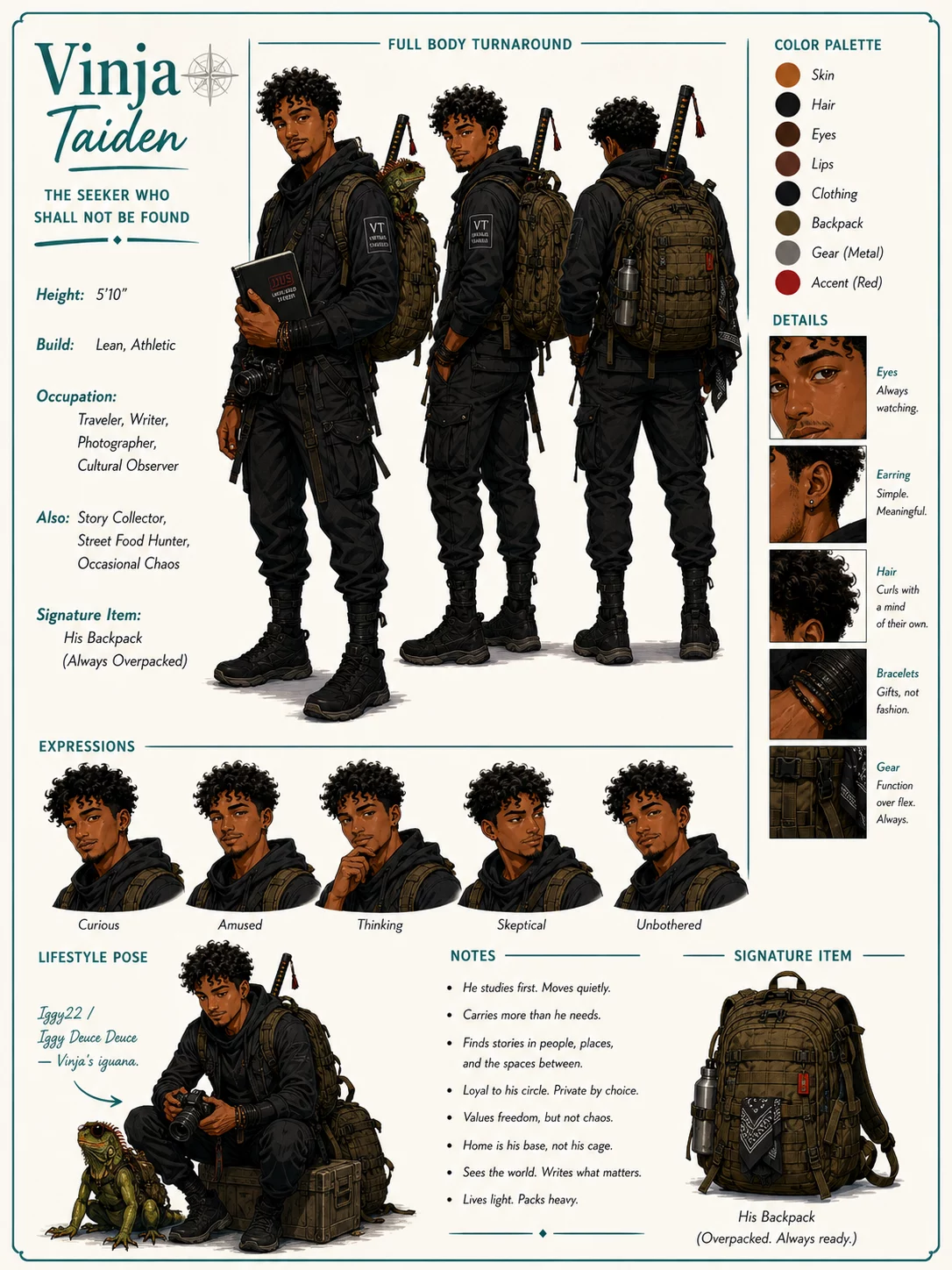 Vinja TaidenCo-lead in Jiejie and Vinja Adventures; solo lead in Where in Asia is Vinja Taiden?
 Iggy22Iggy22 — spoken as Iggy Deuce Deuce — is Vinja’s stylish green iguana companion, silent judge, and self-appointed authority over the house, backpack, and unattended food.