
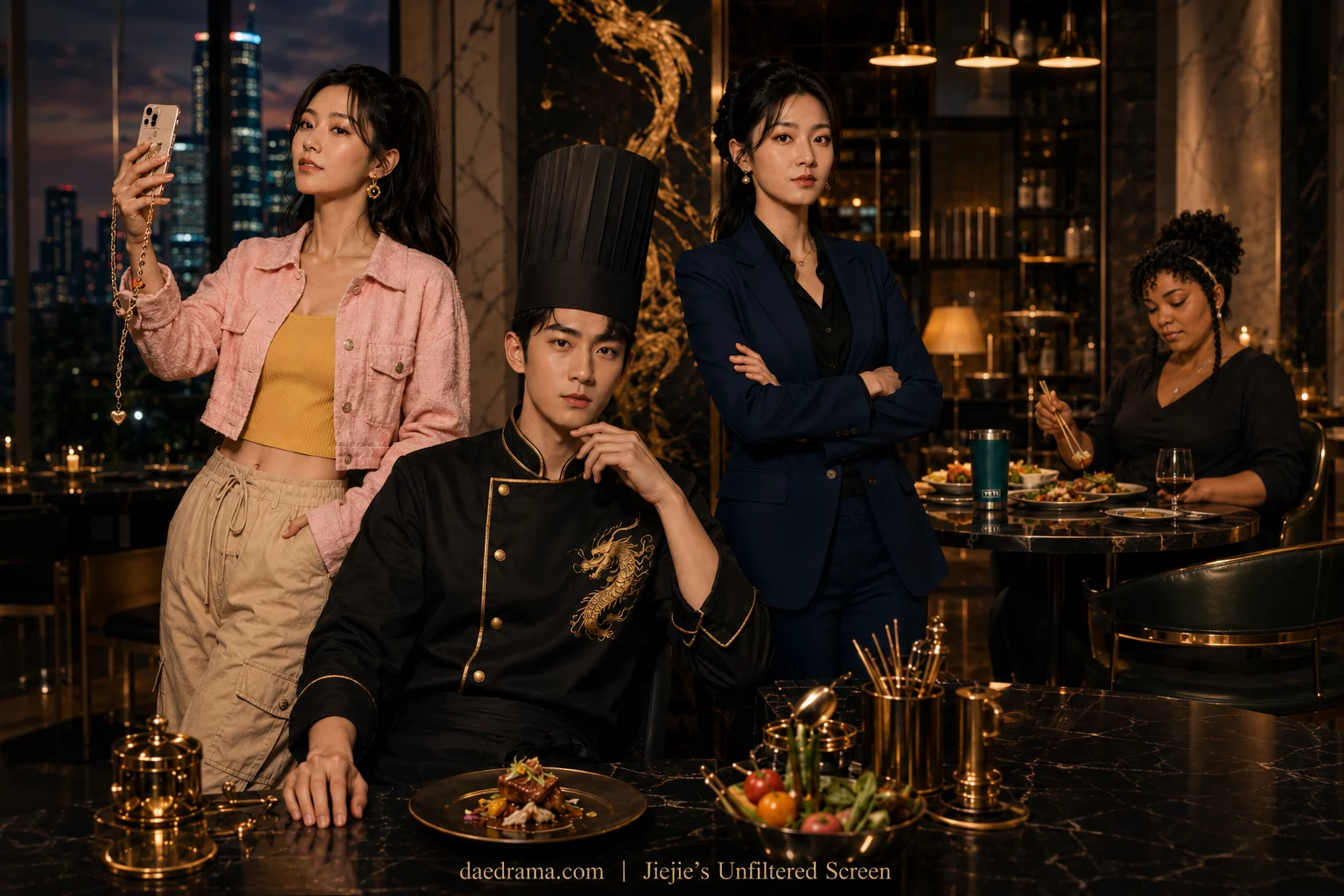
ADAPTATIONS · CONTENT COMPARISON
Chef Son-In-Law
Da Guo Ming Chu ↔ Chef Son-In-Law
I KNOW THE SOURCE
Substantially reworked
What changes when Da Guo Ming Chu moves to screen? Screen additions and screen-side differences are brought forward; the underlying comparison is unchanged.
The screen version retains Qiao Zhi, Tao Ruxue, his imperial-chef inheritance, the Tao-family/Huai Xiang restaurant setting, the Canteen storyline and a cooking-competition rise, but rebuilds the dramatic engine around Qiao's return from overseas, his grandfather Qiao Sihai's grievance, a newly formed contract marriage and a centralized restaurant-industry revenge conflict.
Coverage: The 24-episode drama appears to draw heavily on recognizable people, restaurant concepts and competition material from the novel's earlier development while restructuring them into a self-contained revenge, marriage and business storyline. The source contains 1,276 chapters and continues far beyond the material represented by the drama, including later national and international culinary competition and business arcs and a three-years-later epilogue. No reliable contiguous chapter-to-episode cut
AT A GLANCE
What happened in adaptation?
11 / 14 reader-visible comparison points. 3 comparison points are protected by the current spoiler settings.
IF YOU WATCH THE DRAMA
What will be new to you?
Screen-side material pulled from the same comparison records.
- Qiao Zhi's starting situation and central objective: The screen version supplies a season-long investigation and revenge objective centered on Qiao Sihai and restoration of the Qiao family's reputation.
- Qiao Zhi's imperial-chef culinary inheritance: The drama presents the inherited dishes, knife work and competition cooking through live-action performance and food imagery.
- Qiao Zhi and Tao Ruxue's marriage: The drama lets the audience see the agreement formed and follows the transition from contractual marriage to an openly emotional partnership.
- Huai Xiang and the Tao family's restaurant business: The drama uses Huai Xiang as a concentrated family-and-corporate battleground connecting the marriage, revenge and restaurant storylines.
- The Canteen / 食堂 restaurant storyline: The screen version concentrates the restaurant's launch and attacks against it into visible dramatic set pieces.
- Qiao Sihai grievance and revenge storyline: The screen version provides the Qiao Sihai mystery, overseas return and restoration-of-family-honor narrative spine.
- Restaurant-industry opposition: The drama gives the business conflict a single recurring antagonist axis that can also carry the revenge storyline.
- Traditional Chinese culinary inheritance: The live-action version can show preparation, finished dishes, kitchen technique and competition presentation directly on screen.
- Narrative scale and career span: The drama supplies a bounded narrative in which its principal family, marriage, antagonist and competition conflicts converge within 24 episodes.
- Food-centered rise narrative: The drama packages the culinary rise into visual contests, restaurant confrontations and a continuous revenge-and-romance arc.
EXPLORE
Compare by topic
Choose a topic or change type. Reader lenses only reorder emphasis; they do not create another dataset.
Showing all topics · KeptClear filters
KeptClose
CharactersQiao Zhi's imperial-chef culinary inheritance
SOURCE
Qiao Zhi possesses an inherited imperial-chef culinary tradition and is already capable of unusually demanding traditional cooking techniques even while occupying a low position in the restaurant kitchen.
Opening chapters and throughoutSCREEN
Qiao Zhi is likewise presented as the descendant of an imperial-chef family whose inherited cooking knowledge and exceptional technique allow him to overcome opponents and restore his family's culinary standing.
Series setup and throughoutHow they relate: Qiao Zhi's identity as an heir to elite traditional Chinese culinary knowledge is a central element retained by the adaptation.
Source gives: The long-form source can spend extended passages on culinary technique, ingredients, preparation and Qiao's reasoning while cooking.
Screen gives: The drama presents the inherited dishes, knife work and competition cooking through live-action performance and food imagery.
KeptClose
World & Setting · Setup spoilerHuai Xiang and the Tao family's restaurant business
SOURCE
Tao Nan Fang is an established restaurant entrepreneur, and the Tao family's Huai Xiang business operates a restaurant chain with locations inside the province and abroad. Qiao Zhi initially works from a low kitchen position within its flagship restaurant.
Chapters 1-3 and laterSCREEN
Huai Xiang is retained as the Tao family's major restaurant group. Qiao Zhi's marriage and cooperation with Tao Nan Fang place him inside the business, and Huai Xiang becomes a recurring target and base of operations during the restaurant-industry conflict.
Early episodes and throughoutHow they relate: The Tao family's established restaurant enterprise survives as an important shared setting, although the drama integrates it more tightly into its centralized revenge and corporate-conflict plot.
Source gives: The source provides extended restaurant-operation and career material across a much longer business trajectory.
Screen gives: The drama uses Huai Xiang as a concentrated family-and-corporate battleground connecting the marriage, revenge and restaurant storylines.
KeptClose
ThemesTraditional Chinese culinary inheritance
SOURCE
Traditional cooking knowledge is central to Qiao Zhi's identity and advancement. The novel repeatedly uses named dishes, knife skills, ingredients and inherited culinary knowledge as consequential story material.
Opening chapters and throughoutSCREEN
The drama likewise centers traditional Chinese cooking and inherited imperial-chef knowledge, staging lost or traditional dishes as demonstrations of Qiao's skill and as part of the conflict over culinary legacy.
ThroughoutHow they relate: The adaptation preserves culinary inheritance as both a source of Qiao's abilities and a thematic foundation for his career.
Source gives: The prose can provide sustained explanation of techniques, ingredients and Qiao's culinary thought process over hundreds of chapters.
Screen gives: The live-action version can show preparation, finished dishes, kitchen technique and competition presentation directly on screen.
SOURCE WORK
Da Guo Ming Chu
Factual source reference, kept separate from the comparison itself.
Source synopsis
Qiao Zhi possesses an imperial-chef culinary inheritance and becomes the Tao family's live-in son-in-law in connection with an obligation owed by his father. Already married to Tao Ruxue when the novel opens, he begins from within the Tao family's Huai Xiang restaurant business, develops his own restaurant career, competes in increasingly large culinary contests and eventually rises to national and international prominence in the restaurant industry.